
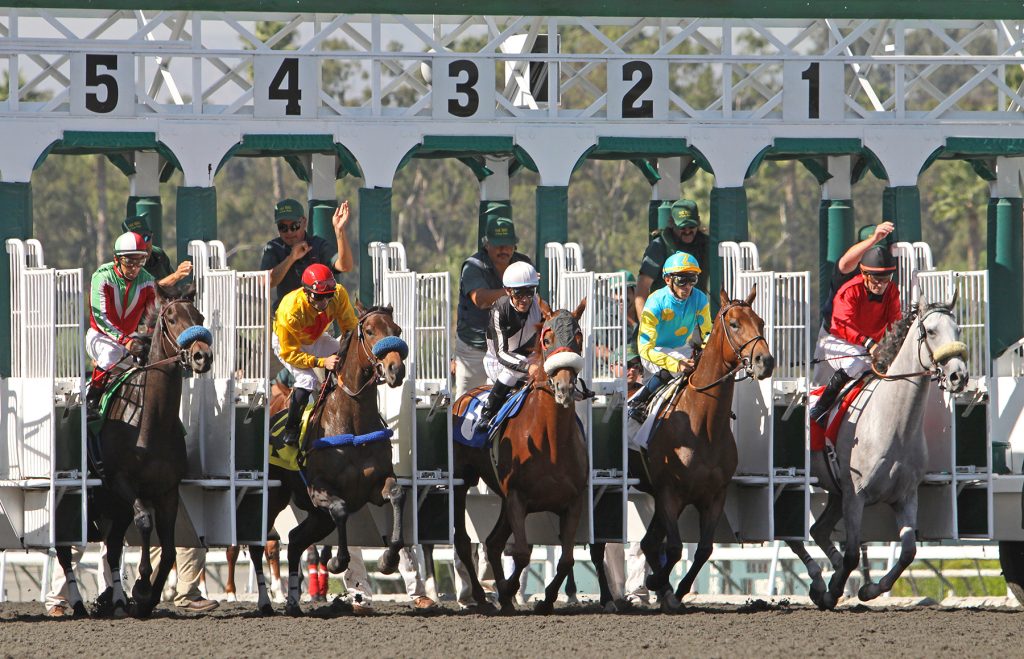
As one who dedicates a fair amount of time towards the pursuit of trying to foretell which equine will reach the wire first, I can emphatically state that the cumulative amount of handicapping literature that is available to horse players these days is downright staggering. Why, my personal library alone consists of more “angles” related to conquering the races than one could probably read in a lifetime. The ironic part is that at its core, thoroughbred horse racing is an extremely simple game. See, to win, all you have to do is bet on the fastest horse.
Alright, I understand that my previous statement resembles something that “Captain Obvious” would proclaim, however, the point I’m trying to make is, we horseplayers tend to make things a lot more complicated than they need to be. Case in point, I have been that individual who dissected the Daily Racing Form to the point that I knew exactly how many oats each horse had for breakfast. In the end however, I learned that the classic handicapping axiom, “study long, study wrong” contains more truth than error.
The real secret to becoming a successful handicapper involves consistently utilizing two or three primary “data points” that a) you wholeheartedly believe in and b) yield steady returns. Personally speaking, my “bread and butter” involves “class handicapping” with an emphasis on recent “Beyer Speed Figures”. (I will breakdown “class handicapping” at a later date since it is a far more detailed field of study.)
Created by Andrew Beyer, a renowned thoroughbred horse racing columnist for the Washington Post, Beyer Speed Figures made their debut inside the Daily Racing Form in 1992. (Note: Beyer Speed Figures were originally unveiled inside Andrew Beyer’s 1975 best-selling book “Picking Winners”.) In summation, what makes Beyer Speed Figures so valuable is that they can oftentimes assign an acutely accurate hierarchy to horses who, on paper, have run very similar races.
Case in point, let’s say you are handicapping the Kentucky Derby (a race that is obviously held at Churchill Downs in Louisville, KY) and you believe that only two equines can realistically secure win honors. Now, suppose “Contender #1” won the 1 1/8 mile Grade 1 Florida Derby (held at Gulfstream Park in Hallandale Beach, FL) last time out in a time of 1:48 2/5. Next, let’s say “Contender #2” won the 1 1/8 mile Grade 1 Santa Anita Derby (held at Santa Anita Park in Arcadia, CA) last time out in a time of 1:48 2/5. On the surface, it would seem that “Contender #1” and “Contender #2” ran identical races last time out, but not so fast my friend.
See, even though “Contender #1” and “Contender #2” logged the same final time regarding a nine-furlong (1 1/8 mile) race, what the handicapper doesn’t know (unless they reference the replay) is that “Contender #1” went wide on both turns while “Contender #2” secured a rail skimming ride (thus saving a ton of ground). Moreover, “Contender #1” was bumped at the break and had to steady himself before he attempted to procure any forward momentum. Oh, and did I mention that “Contender #1” ran on a slow deep strip while “Contender #2” competed on a lightning-fast course? This all translates into the following: what you can’t see on paper is that “Contender #1” ran the much better race than his forthcoming competitor. Thus, this is why (theoretically) “Contender #1” received a Beyer Speed Figure of 102 for his most recent performance while “Contender #2” earned a significantly lesser rating of 97.
At this point you are probably awakening to the truth that a thoroughbred’s Beyer Speed Figure can tell you more in two seconds than you could otherwise deduce (even with the aid of video replays) in an hour. Truth be told, I for one believe that Beyer Speed Figures are the horseplayer’s ultimate “cheat sheet”. Meaning, if you procrastinate up until the moment when they start loading into the gate (admit it, we’ve all been there), you can actually make a reasonably informed decision based on Beyer Speed Figures alone.
Obviously, I would never recommend attempting to “figure” a race based on only one “data point”, no matter its perceived potency. Rather, I would advocate that you reserve a place for Beyer Speed Figures on your “Handicapping Mount Rushmore” alongside a racer’s: class rating, connections (trainer & jockey) and bloodlines. (As a caveat, I’ll likewise mention that while time consuming, analyzing race replays can levy a significant edge.) All told, if a horseplayer commits to utilizing Beyer Speed Figures in conjunction with a few other time-tested handicapping principles, they’ll be equipped with a strategy that will undoubtedly bolster not just their confidence, but their ROI as well.
By Eric Floyd
CLICK HERE for more horseracing tips and articles.