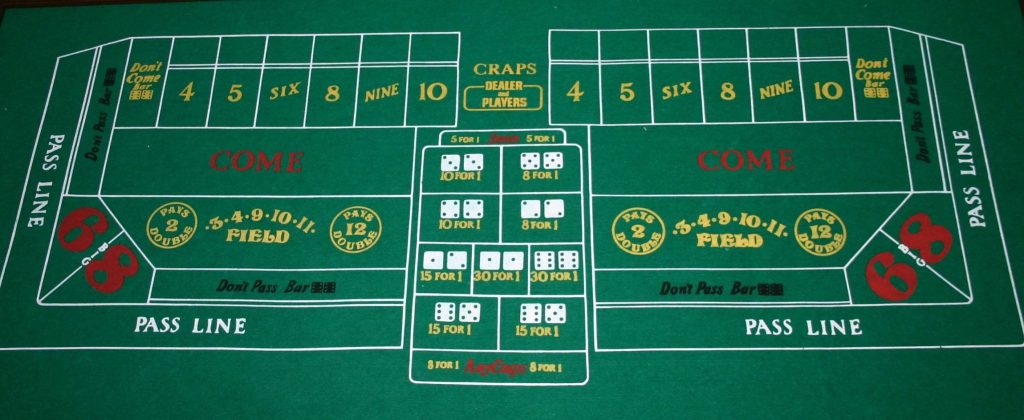
 Craps creates the illusion that action equals opportunity. Chips are everywhere. Dealers call bets rapidly. Players can wager on individual numbers, combinations, hardways, totals and outcomes that may resolve on the very next roll.
For the advanced player, the important question is not how many bets can be made, it is how much mathematical cost is attached to each dollar of action.
Consider two players who walk to the same $25 craps table with identical $500 bankrolls. Player A begins with $25 on the Pass Line. Once a point is established, he takes odds behind the line, using a larger portion of the bankroll on a wager that pays true mathematical odds. Player B also starts with $25 on the Pass Line but quickly adds a Field bet, a hardway and an “Any Craps” wager because he wants more ways to win on every roll. They have the same money on the felt, but not the same quality of action.
The Baseline: Pass and Don’t Pass
The standard Pass Line has a house edge of about 1.41%. The Don’t Pass is slightly lower at roughly 1.36%, with a push on 12 on the come-out roll. Those are relatively efficient casino wagers. More importantly, once a point is established, the player can take or lay odds. Proper odds bets carry no house edge because they pay according to the true probability of the point being made before a seven.
That does not make the overall game even-money. The original line bet still carries its disadvantage. But adding odds increases the amount wagered without adding another house edge to the odds portion.
Why the 6 and 8 Matter
Players who like direct number action should pay particular attention to the 6 and 8. A standard Place 6 or Place 8 bet pays 7-to-6 and carries a house edge of about 1.52% per resolved bet. That is close to the Pass Line and far more efficient than many center-table wagers. By comparison, placing the 5 or 9 carries about a 4% house edge, while placing the 4 or 10 at standard 9-to-5 payouts carries about a 6.67% edge. Their mathematical prices are not the same.
The Expensive Action in the Middle
Now we’ll look at several bets that create excitement. An Any Craps wager—winning when the next roll is 2, 3 or 12—commonly carries an 11.11% house edge. Hard 4 and Hard 10 are also around 11.11% under standard payouts. Hard 6 and Hard 8 are roughly 9.09%. A Field bet can vary depending on how the 2 and 12 pay. When the 12 pays triple, the edge is much lower than when both 2 and 12 pay only double, but it still generally costs more than the best line and place wagers. This does not mean an experienced player can never make a fun proposition bet. Know the price before calling it a “strategy.”
The $500 Comparison
Imagine Player A wagers $25 Pass and, after a point, adds $75 in odds when the table permits. He may have $100 exposed, but $75 of that wager carries no house edge. Player B has $25 Pass, $25 Field, $25 Hard 8 and $25 Any Craps. He also has $100 exposed, yet three quarters of his action is attached to bets with meaningfully larger mathematical disadvantages. One lucky roll can make Player B look brilliant. A 12 could generate multiple payouts and a celebration. Over repeated sessions, however, the casino does not care which player had the louder win. It cares about the average mathematical value of every wager placed.
Bankroll Strategy
With only $500 at a $25 table, the advanced player also needs to recognize volatility. Ten or twenty betting units can disappear quickly even with efficient wagers. That is why “maximum odds” is not automatically appropriate for every bankroll. Zero house edge on the odds portion does not mean zero risk. Large odds create larger swings. A disciplined approach may use smaller odds early, increasing only if the bankroll and table limit support it. The goal is to combine strong wagers with a betting structure that allows enough decisions to enjoy the session.
Dark Side Mathematics
The Don’t Pass wager offers a slightly lower house edge than the Pass Line, which is why mathematically focused players sometimes prefer the “dark side.” The difference is small: approximately 1.36% versus 1.41%. Because the Don’t player often wins when the rest of the table loses, the social experience is different. If that spoils the fun, the Pass Line with odds remains an efficient mainstream choice.
Know What You Are Buying
Craps is one of the best casino games for showing the difference between risk and price. Two $25 wagers can have identical dollar exposure and very different expected costs. The smartest approach is to build most of the session around low-house-edge bets, understand how odds work and reserve higher-cost propositions for occasional entertainment rather than treating them as the foundation of a system. No betting pattern can change independent dice into a guaranteed profit. Pressing after wins, reducing after losses or waiting for a “hot shooter” does not rewrite the probabilities. But wager selection matters. That is the advanced craps edge—not beating the house, but refusing to pay a premium for action when the table offers better-priced ways to play.