
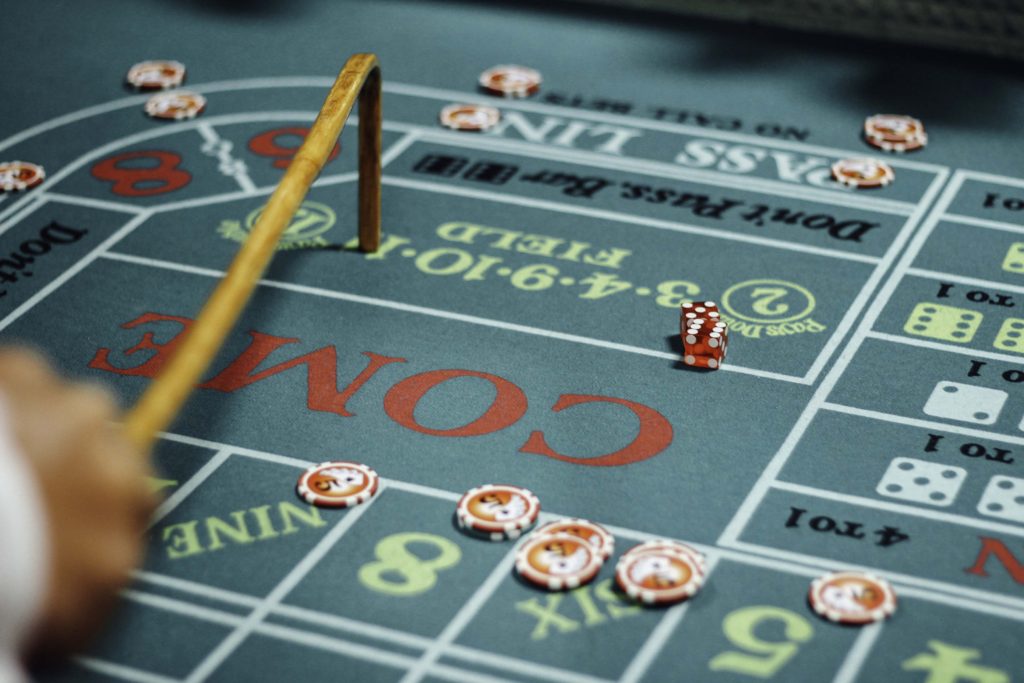
Few casino experiences match the excitement of a lively craps table. Chips clatter across felt, players cheer in unison, and strangers become teammates with every winning roll. The game’s fast pace and communal spirit create one of the most electric atmospheres in any casino. Beneath the noise and celebration, however, craps is governed by precise mathematics. Players who understand probability and bet selection can enjoy the spectacle while keeping the house edge remarkably low.
At its core, craps is a game built on the probabilities of two six-sided dice. With 36 possible combinations, certain totals appear far more frequently than others. A roll of seven is the most common outcome, appearing in six combinations (16.67%). Totals of six and eight appear in five combinations each (13.89%), while five and nine occur four ways (11.11%). Four and ten appear three ways (8.33%), and the least likely totals — two and twelve — appear only once (2.78%). These probabilities form the mathematical backbone of every wager on the table.
The Pass Line bet serves as the foundation of smart craps play. On the come-out roll, a 7 or 11 wins immediately, while 2, 3, or 12 loses (with 12 pushing in some casinos). Any other number establishes the “point.” Once a point is set, the shooter must roll that number again before rolling a 7 for the Pass Line bet to win. This wager carries a house edge of just 1.41 percent, making it one of the best bets in the casino.
Where savvy players gain a significant advantage is by taking odds behind their Pass Line bet once the point is established. Odds bets pay true mathematical odds and carry zero house edge. If the point is 4 or 10, odds pay 2:1; on 5 or 9 they pay 3:2; and on 6 or 8 they pay 6:5. Casinos typically allow double, 3x–4x–5x, or even 10x odds. The more odds you take, the lower the combined house edge becomes. For example, with 5x odds, the effective house edge drops to roughly 0.33 percent, rivaling the best blackjack games.
Come bets function identically to Pass Line bets but can be placed after a point is established, allowing players to build multiple numbers working simultaneously. Backing Come bets with odds offers the same zero-edge advantage, making them a cornerstone of disciplined craps strategy.
Players looking for additional low-edge wagers often place bets on the 6 and 8. These numbers appear most frequently after the seven, and place bets on them carry a house edge of about 1.52 percent. Many experienced players place both numbers and press winnings gradually, capitalizing on their relatively high probability.
In contrast, the center section of the table is filled with proposition bets designed for excitement rather than value. Hardways bets (such as hard 8 or hard 6) can carry house edges around 9–11 percent depending on payouts. One-roll bets are even steeper: “Any 7” carries a house edge of 16.67 percent, while “Any Craps” sits around 11.11 percent. These wagers deliver dramatic payouts but drain bankrolls quickly. Experienced players treat them as entertainment splurges rather than core strategy.
A persistent myth surrounding craps is the concept of dice control or influence. Some enthusiasts claim that controlled throws can reduce randomness. While consistent throwing techniques may produce uniform motion, no scientific evidence demonstrates that players can reliably influence outcomes over time. Casinos allow consistent shooters but rely on the statistical independence of each roll.
Bankroll management plays a critical role in craps because the game’s pace can be rapid. A shooter’s hand may last seconds or stretch into dozens of rolls. Establishing a session budget, taking odds within comfortable limits, and resisting the urge to chase losses help maintain discipline. Many players increase odds rather than base bets when pressing action, preserving value while maximizing returns.
Craps also rewards patience. Not every roll demands a wager, and sitting out cold tables is a common practice among experienced players. Observing table rhythm, shooter consistency, and bankroll health can be just as important as the bets themselves.
Ultimately, craps is a game of controlled enthusiasm. By focusing on Pass Line and Come bets, taking full odds, and favoring place bets on the 6 and 8, players can reduce the house edge to some of the lowest levels in the casino. Avoiding high-edge proposition bets and embracing disciplined bankroll management ensures the excitement remains sustainable.
Craps rewards knowledge, restraint, and smart decision-making. Beneath the cheers and high-fives lies a game where probability rules — and players who respect the math can turn the casino’s most energetic table into one of its smartest plays.
CLICK HERE for more craps tips and strategies.