
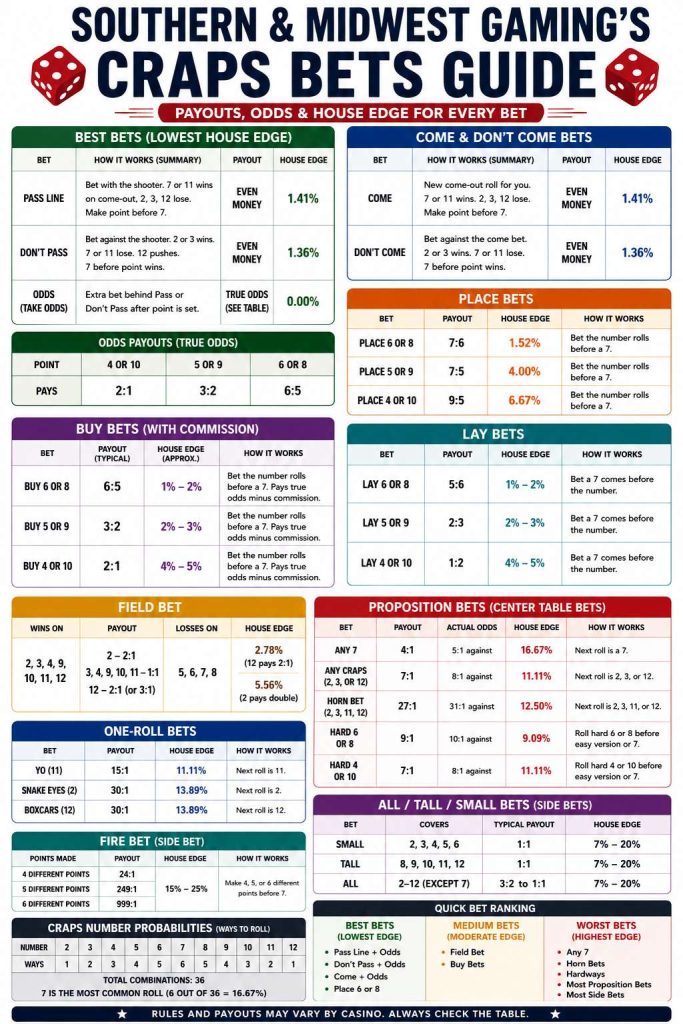
Craps is one of the most psychologically fascinating games in the casino because the energy of the table often overrides the mathematics of the wagers. Players cheer for hot rolls, celebrate long streaks, and emotionally align themselves with the shooter. Yet from a purely statistical perspective, one of the strongest bets in the casino is rooted in betting against that excitement: the Don’t Pass line.
The Don’t Pass bet is effectively the inverse of the Pass Line. Instead of wagering that the shooter will establish and successfully make a point, the bettor is wagering that the shooter will fail. Emotionally, many players dislike the wager because it positions them against the table’s momentum. Mathematically, however, it is one of the lowest-house-edge bets available in craps.
On the come-out roll, the Don’t Pass loses immediately if the shooter rolls 7 or 11, but wins if the shooter rolls 2 or 3. A roll of 12 typically results in a push. Once a point is established — 4, 5, 6, 8, 9, or 10 — the Don’t Pass bettor wins if a 7 appears before the point repeats.
This is where the statistics become powerful.
The number 7 is the most probable outcome in craps because six combinations produce it:
1-6, 2-5, 3-4, 4-3, 5-2, and 6-1.
No other number appears as frequently. By comparison:
6 and 8 each have five combinations
5 and 9 each have four
4 and 10 each have three
Because 7 appears most often, the shooter is statistically vulnerable once a point is established. For example, if the point is 4, the shooter has only three combinations to make the point but six combinations to roll a 7 and lose. That means the Don’t Pass bettor has a 66.7% probability advantage before considering additional rolls.
The overall house edge on the Don’t Pass bet is approximately 1.36%, slightly better than the Pass Line at roughly 1.41%. While the difference appears small, over extended sessions it becomes meaningful, especially for disciplined players making large wagering volume.
The true power move in craps, however, is backing the Don’t Pass with odds. Odds bets are unique because casinos charge no house edge whatsoever on the odds portion of the wager. The payout reflects true mathematical probability.
For example:
Odds behind 4 or 10 pay 2-to-1
Odds behind 5 or 9 pay 3-to-2
Odds behind 6 or 8 pay 6-to-5
Because these payouts are mathematically accurate, the odds bet carries zero casino advantage. As players increase odds multiples — such as 2x, 5x, or even 100x odds in some casinos — the blended house edge on total action decreases dramatically.
A player making maximum odds behind the Don’t Pass can reduce the effective casino advantage to below 0.5%, rivaling optimal blackjack strategy. Few casino wagers offer such efficiency.
Another advanced concept favoring Don’t Pass bettors is regression to probability. While hot shooters create excitement, extremely long rolls are statistically rare. The median hand in craps remains relatively short because the probability of eventually rolling a 7 steadily compounds with every toss. Over time, the mathematics relentlessly favor the appearance of the seven.
Professional gamblers and advantage-minded players often embrace the Don’t Pass not because it is glamorous, but because it aligns with statistical reality. Craps tables thrive on emotion and crowd psychology, yet the disciplined bettor understands that casinos are defeated not by enthusiasm, but by exploiting wagers with the smallest possible edge.